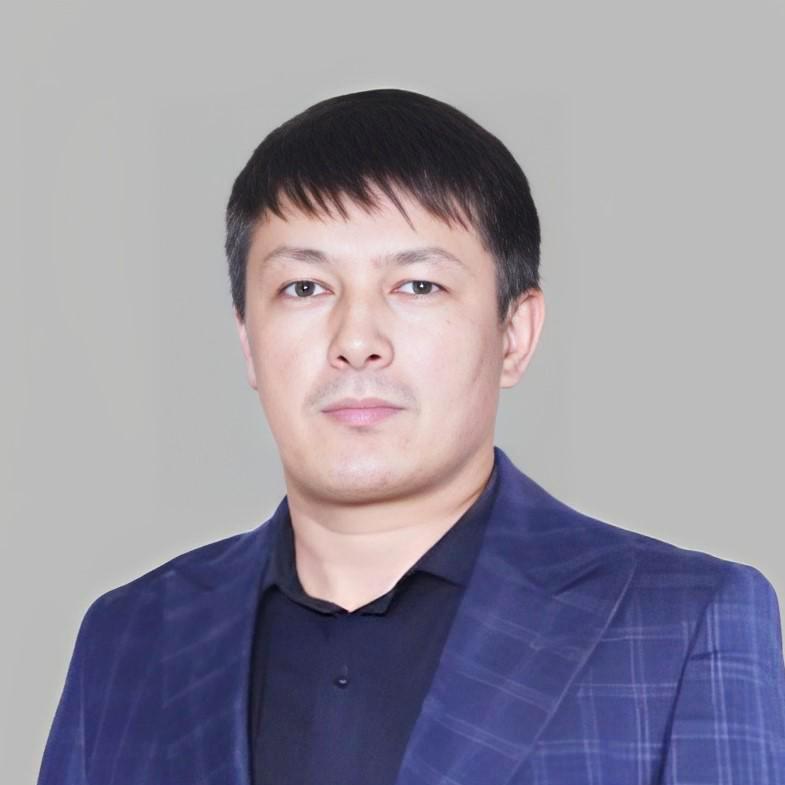
Professional experience • 2008/07 - 2011 /03, Programmer of JSC ” National center of informatization” Almaty, Kazakhstan
• 2011/03 - 2014 /08, Lead programmer of JSC ”National Information Center” Almaty, Kazakhstan
• 2014/09 – 2017/09, Lecturer, Al–Farabi Kazakh National University, Almaty, Kazakhstan
• 2017/09 – now, Researcher, Institute of Mathematics and mathematical modeling, Almaty, Kazakhstan
• 2018/09 – 2024/09, Senior Lecturer, Al–Farabi Kazakh National University, Almaty, Kazakhstan
• 2024/09 – now, Associate Professor, International Engineering Technological University, Almaty, Kazakhstan
Education2004 - 2008 Satbayev Kazakh National Technical University. Bachelor`s degree in "050704 - Computer Science and Software".
2011 - 2013 Satbayev Kazakh National Technical University. Master`s degree in 6M060200 - Computer Science.
2017 - 2020 Al-Farabi Kazakh National University. PhD in 6D075100 - Computer Science, Engineering and Management.
Scientific interests"AP14972032 - Numerical Study of the Wave Equation with Irregular Coefficient"
Publications
- Arshyn Altybay, Niyaz Tokmagambetov, Numerical simulation and parallel computing of acoustic wave equation in isotropic-heterogeneous media. CMES-Computer Modeling in Engineering & Sciences, 2024. (Accepted) Percentile = 62
- Arshyn Altybay, Dauren Darkenbayev, Nurbapa Mekebayev. Parallel numerical simulation of the 2D acoustic wave equation. International Journal of Electrical and Computer Engineering (IJECE) Vol. 14, No. 6, 2024. (Accepted) Percentile = 66
- Arshyn Altybay; Dauren Darkenbayev; Nurbapa Mekebayev. Numerical simulation and GPU computing for the 2D wave equation with variable coefficient. International Journal of Simulation and Process Modelling (IJSPM), Vol. 20, No. 4, pp.298 – 305, 2023 Percentile = 45,
- Altybay A., Darkenbayev D, Nurbapa Mekebayev. . A GPU implementation of the tsunami equation Scientific Journal of Astana IT University. – 2023. – Vol. 13. – P. 24–31.
- Temirbekov, A., Altybay, A., Temirbekova, L., Kasenov, S. Development of parallel implementation for the Navier-Stokes equation in doubly connected areas using the fictitious domain method. Eastern-European Journal of Enterprise Technologies. – 2022. – Vol. 2. № 4. – P. 38–46.
- Altybay A., Ruzhansky M., Tokmagambetov N. Wave equation with distributional propagation speed and mass term: numerical simulations. Applied Mathematics E-Notes. – 2019. – Vol. 19. – P. 552-562.
- Altybay A., Ruzhansky M., Sebih M. E., Tokmagambetov N. Fractional Klein-Gordon equation with singular mass. Chaos, Solitons Fractals. 2021. –Vol. 143. – P. 110579-110647.
- Altybay A., Ruzhansky M., Sebih M. E., Tokmagambetov N The heat equation with strongly singular potentials. Applied Mathematics and Computation. – 2021. – Vol. 399. – P. 126-132.
- Altybay A., Ruzhansky M., Sebih M. E., Tokmagambetov N. Fractional schr¨odinger equation with singular potentials. Reports on Mathematical Physics. – 2021. – Vol. 87. №1. – P. 129-144
- Altybay A., Ruzhansky M., Tokmagambetov N. A parallel hybrid implementation of the 2D acoustic wave equation. International Journal of Nonlinear Sciences and Numerical Simulation. – 2020. – Vol. 21, Iss. 7-8. – P. 821-827
- Altybay A., Tokmagambetov N. MPI parallel implement of a wave equation using an implicit finite difference scheme. KBTU Bulletin. – 2020. №1(52). – P. 112-120.
- Altybay A., Tokmagambetov N. GPU computing for 2d wave equation based on implicit finite difference schemes. Bulletin NIA RK. – 2020. №3(77). – P. 32-42.
- Altybay A., Tokmagambetov N. A parallel algorithm for solving the two-dimensional wave equation with a singular coefficient. KazNTU Bulletin. – 2019. – Vol. 1. – P. 404-410.
- Altybay A., Tokmagambetov N. On numerical simulations of the 1D wave equation with a distributional coefficient and sourse term. International Journal of Mathematics and Physics. –2017, – Vol. 8, №2
Disciplines taught
The purpose of the discipline is to form masters' practical skills to verify or prove the absence of errors in sequential and parallel algorithms implemented on object-oriented software. As a result of the training, the master's student will be able to develop software products qualitatively, apply in professional activity the basic skills necessary to participate in the verification of complex software.
The purpose of the discipline is the formation of theoretical knowledge and practical skills among students in the field of creating and applying databases in automated control systems, acquiring the necessary competencies in designing the logical structure of the database, interfaces for working with the database. The discipline studies network protocols, architectures, technologies and applications, computer networks, ISO OSI and TCP/IP, as well as automation and management of systems and networks; modeling of local networks; Ethernet, Token Ring, FDDI, wireless networks.
The purpose of the discipline is a deep understanding of the principles of object-oriented programming, teaching the use of various technologies of the .NET Framework, Microsoft: LINQ, ADO.NET, WCF, WPF, studying the relationship between classes, developing large software systems using the .NET platform and the C# language. Upon completion of the course, the student will be able to develop software systems using .NET, C#, LINQ, WPF, WCF, MSSQL.
The goals and objectives of the discipline is to study the Android mobile platform, gain practical skills in creating user interfaces, services, the ability to develop applications for mobile devices, install software for mobile devices; independently develop applications and programs for various platforms and devices running Android operating systems; create applications for mobile devices.
Learning outcomes: after completing the course, the student must know: the peculiarities of the architecture and hardware environment of mobile devices, how to install mobile applications in different operating systems; features of the architecture of mobile devices in terms of programming; Android OS device and architecture; capabilities of tools for developing applications for Android OS. be able to: create mobile Java applications (midlets); complete the stages of software development in AndroidStudio or Eclipse environments; create background services, alarms and connection mechanism notifications, create programs for Android OS.
The purpose of the discipline is to design robotic systems using artificial intelligence and neural networks. As a result of the training, the student will be able to design models of mobile mechanisms for robotic systems using artificial intelligence and neural networks, to carry out their assembly and operation.
The purpose of the discipline is the formation of practical skills in project management for students, which allows them to make qualified decisions on the implementation of automation and informatization projects of enterprises. As a result of the training, the student will be able to solve complex professional tasks in planning an IT project, in the methodology of developing and implementing innovative IT projects in various fields using modern software tools.
The purpose of the discipline is to form masters' knowledge on the main directions of the progress of software development technology, skills of making independent decisions on quality management of the software development process. As a result of the training, the master's student will be able to guarantee the quality of the products being developed, ensuring that there are no errors in the program code and be responsible for the created software products.
Opening lessons