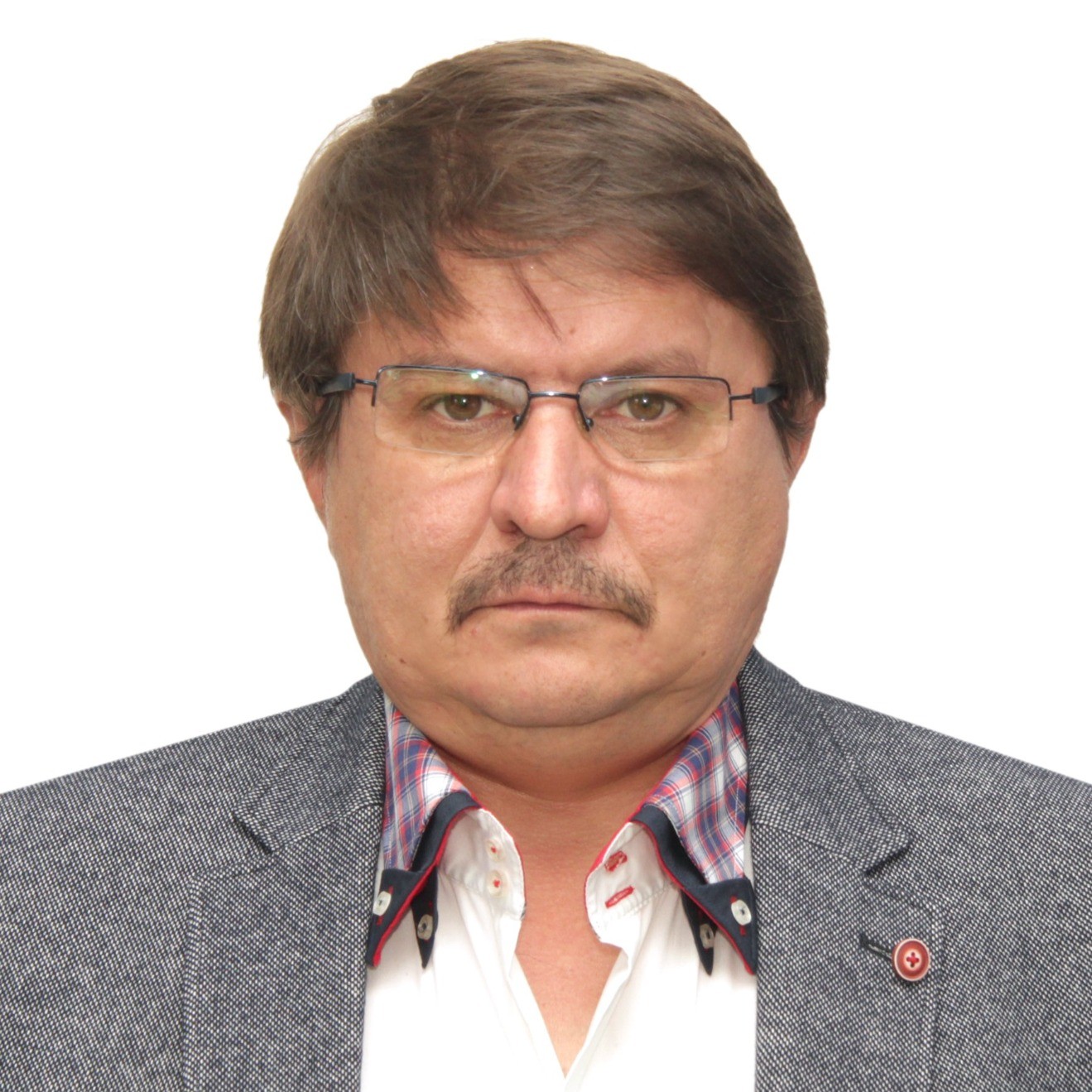
Профессиональный опыт профессор, д.х.н, к.ф-м.н., акад. Национальной инженерной Академии РК.
Образование1980 - 1986 Ленинградский госуниверситет. Физик, Специальность – 2016, диплом МВ № 405 695.
Научные интересы1. AP05132138 «Разработка технологии производства комплексных самоокупаемых систем очистки и кондиционирования городского воздуха».
2. AP14870281 «Разработка новых подходов к цифровой обработке изображений с использованием сверточных нейронных сетей».
3. AP14870416 «Разработка новых подходов к решению философских проблем многозначной логики как средства установления закономерностей мышления».
4. BR24992908 «Система поддержки агротехнических мероприятий в растениеводстве на базе комплекса средств мониторинга и методов искусственного интеллекта (Agroscope)».
5. AP23490107 «Разработка теоретико-информационных методов описания преобразователей волновых сигналов на основе использования конечных алгебраических структур»
Публикации
-
Vitulyova Y., Kadyrzhan K., Kadyrzhan A., Shaltykova D., Suleimenov I. Reducing the description of arbitrary wave field converters to tensor form // International Journal of Information Technology. – 2025. – Vol. 17, № 6. – С. 3275–3284.
-
Shaltykova D., Kadyrzhan K., Suleimenov I., Seitenova G., Kopishev E. Application of Fourier-Galois Spectra Analysers for Rotating Image Analysis // Polymers. – 2025. – Vol. 17, № 13. – P. 1791.
-
Gabrielyan O. A., Suleimenov I. E. Objective Foundations of Ethics and Prospects for Its Development: Information and Communication Approach // Conatus Journal of Philosophy. – 2025. – Vol. 10, № 1. – С. 111–125.
-
Suleimenov I., Dyussova R., Shaltykova D., Seitenova G., Kopishev E. Prerequisites for Developing a Classification of Phase Transitions in Systems Based on Thermosensitive Polymers: Use of a Semi-Empirical Model // Polymers. – 2025. – Vol. 17, № 11. – P. 1441.
-
Kabdushev S., Gabrielyan O., Kopishev E., Suleimenov I. Neural network properties of hydrophilic polymers as a key for development of the general theory of evolution // Royal Society Open Science. – 2025. – Vol. 12, № 4. – P. e2120037119.
-
Suleimenov I., Bakirov A. Prospects for Using Finite Algebraic Rings for Constructing Discrete Coordinate Systems // Symmetry. – 2025. – Vol. 17, № 3. – P. 410.
-
Kadyrzhan A., Matrassulova D., Vitulyova Y., Suleimenov I. Discrete Cartesian Coordinate Transformations: Using Algebraic Extension Methods // Applied Sciences (Switzerland). – 2025. – Vol. 15, № 3. – P. 1464.
-
Kadyrzhan K., Suleimenov I., Tolymbekova L., Seitenova G., Kopishev E. Background of New Measurement Electronic Devices with Polyelectrolyte Hydrogel Base // Polymers. – 2025. – Vol. 17, № 4. – P. 539.
-
Suleimenov I., Gabrielyan O., Matrassulova D. Philosophical Foundations of Sciences and Prospects of Multivalued Logic in Describing Thinking // Science and Education. – 2025. – In press.
-
Suleimenov I. E., Gabrielyan O. A., Bakirov A. S. Initial study of general theory of complex systems: physical basis and philosophical understanding // Bulletin of Electrical Engineering and Informatics. – 2025. – Vol. 14, № 1. – С. 774–789.
-
Kadyrzhan A., Kadyrzhan K., Bakirov A., Suleimenov I. Prospects for the Use of Quasi-Mersen Numbers in the Design of Parallel-Serial Processors // Applied Sciences (Switzerland). – 2025. – Vol. 15, № 2. – P. 741.
-
Bakirov A., Matrassulova D., Vitulyova Y., Shaltykova D., Suleimenov I. The specifics of the Galois field GF(257) and its use for digital signal processing // Scientific Reports. – 2024. – Vol. 14, № 1. – P. 15376.
-
Kadyrzhan A., Bakirov A., Shaltykova D., Suleimenov I. Application of the Algebraic Extension Method to the Construction of Orthogonal Bases for Partial Digital Convolutions // Algorithms. – 2024. – Vol. 17, № 11. – P. 496.
-
Suleimenov I., Gabrielyan O., Kopishev E., Bakirov A., Vitulyova Y. Advanced Applications of Polymer Hydrogels in Electronics and Signal Processing // Gels. – 2024. – Vol. 10, № 11. – P. 715.
Преподаваемые дисциплины
Дисциплина посвящена изучению методологии научных исследований, современных методов научного познания и организации исследовательской деятельности. Рассматриваются подходы к планированию и проведению научных исследований, выбору методов сбора и анализа данных, моделированию и имитации процессов, обработке результатов экспериментов, оценке их достоверности, а также принципам интерпретации и представления научных результатов.
Открытое занятие