Stage III of the AI-Sana Program: From Student Ideas to Real Startups
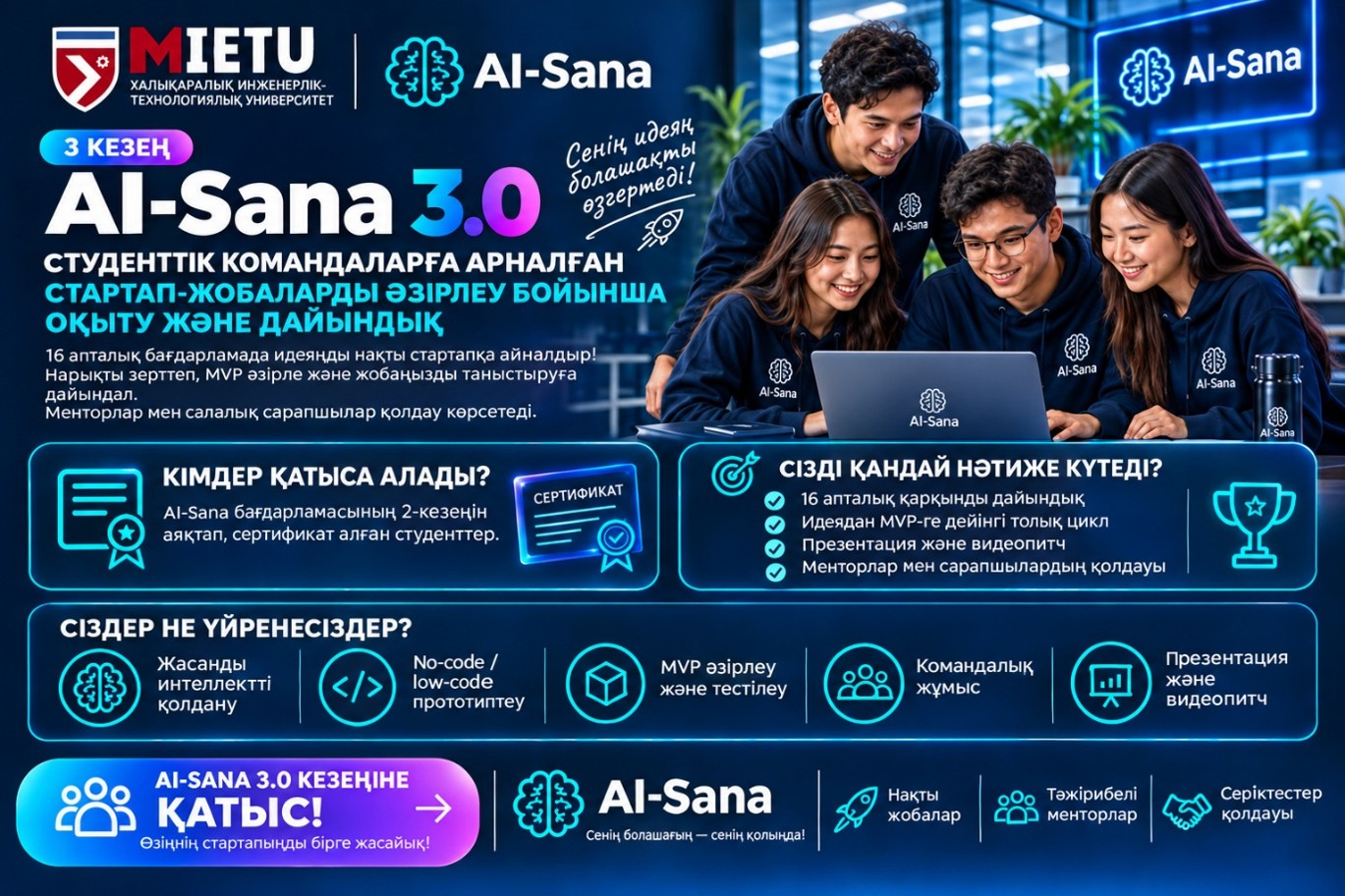
AI-Sana at the International Engineering and Technological University
- Duration: 16 weeks, with a weekly commitment of 15–17 hours;
- Study workload: approximately 235 mandatory hours;
- Start date: December 2026;
- Teaching team: 40 experienced speakers;
- Projects: covering more than 12 industries;
- Final project: a minimum viable product (MVP) for your own startup;
- Certificate: AI-Sana Stage III completion certificate.
Stage III of the AI-Sana program enables students to apply their knowledge in practice and develop their own AI-powered products. Over 16 weeks, participants will not only master new tools but also complete the entire development journey — from building a neural network and analysing a specific industry problem to creating a working MVP.
Students will learn to identify problems that artificial intelligence can genuinely solve, assess the potential value of their solutions, and turn technical ideas into products that can be presented to employers, mentors, accelerators, or investors.
Academic Lead
Paul Kim — a prominent American expert in educational technology (EdTech), professor, and Chief Technology Officer (CTO) at the Stanford University Graduate School of Education.
Learning takes place on two platforms:
- Platonus — the program's primary learning platform;
- Stanford SMILE — the platform for completing assignments, taking examinations, developing the final project, and assessing student work.
Classes on Platonus are available in Kazakh, Russian, and English. Assignments on SMILE are provided in English.
Approximately 60,000 students who have completed the previous selection stages and educational modules are participating in Stage III. At this stage, the focus shifts from acquiring foundational knowledge to developing practical digital and industry-specific products.
Student teams develop their projects under the guidance of experienced experts and mentors. Participants design solutions, adapt them to real market needs, and develop scaling strategies. At the end of the program, teams will present their products to American investors.
Build Your Own AI Solution for Real Industry Challenges
Stage III of AI-Sana is designed for participants who have completed the first program and are ready to move forward. Contributors include venture investors from Alpha Intelligence Capital and IFC, founders of unicorn companies, lawyers from Wiley Rein, and Kazakhstani entrepreneurs with experience in the Stanford and Silicon Valley ecosystems.
The program is intended for those who want to go beyond a local project and build a company capable of entering the global market.
Stage III Is Right for You If:
- You have completed AI Sana Program 1;
- You are ready not only to study artificial intelligence but also to write code to solve specific problems;
- You want to understand how real production and business processes work and where AI can add value;
- You are ready to work in a team of five and develop a project you can confidently present to an investor.
This is a demanding program. Each week includes programming in Google Colab, studying course materials, teamwork, and assessment on SMILE.
The final project is not an essay. It is a working MVP accompanied by a presentation and a video pitch, prepared for an investor audience.
What You Need to Know Before Starting
Participants need basic Python skills, an understanding of core machine learning principles, and confidence in using Google Colab and generative AI.
These skills are covered in AI Sana Program 1. If you identify gaps in your knowledge, review the first module's materials before starting work on your startup.
English proficiency is also important. The final video pitch must include English subtitles so that investors in San Francisco, Singapore, and other international hubs can evaluate it.
Program speakers deliver their sessions in English, and documents used by investment fund representatives are also prepared in English. Working with English-language materials over 16 weeks will help participants develop their professional communication and negotiation skills in an international setting.
What You Will Learn in Stage III
Understand AI Systems — and Build Them
You will write a neural network from scratch, refine a convolutional neural network (CNN), fine-tune a language model using QLoRA, and build a retrieval-augmented generation (RAG) pipeline with FAISS.
By the end of the first module, you will create a robot prototype capable of holding a conversation, retaining context, and learning to navigate its environment. You will implement these components yourself in Google Colab.
Understand How Industries Actually Work
Before proposing an AI solution, you need to understand the process you intend to improve.
You will learn to identify bottlenecks, calculate return on investment (ROI), and distinguish AI's practical value from attractive but unsupported claims. Practical case studies cover 11 industries.
Develop Skills That No Model Can Replace
Paul Kim's approach to leadership is based on six principles: communication, collaboration, creativity, critical thinking, compassion, and commitment.
While artificial intelligence generates content, people give it meaning. This module explores how to build trust, take responsibility, and lead a team.
One of the most important outcomes of Stage III is understanding what global investors and industries genuinely need.
Participants will gain insights directly from partners at funds managing hundreds of millions of dollars and professionals implementing AI technologies at Novartis, Snowflake, and Interactive Brokers. This experience will help them develop startups designed for international markets from the outset.
How the Program Is Structured
The design of Stage III draws on more than two decades of educational technology research at Stanford.
- The six principles of 6C leadership: Communication, Collaboration, Creativity, Critical Thinking, Compassion, and Commitment;
- Practice comes first: each topic follows a "Lecture → Experiment → Lecture → Experiment" cycle. Participants do more than listen: they modify parameters, test model behaviour, observe the results, and investigate the reasons behind them;
- Teams of five: all Stage III projects are completed collaboratively. This is not simply an assessment format — real products are built through teamwork. The ability to reach agreements under pressure and meet deadlines is just as important as programming skills.
Modules of the 16-Week Program
1. Foundations of AI Programming
The program's most extensive module includes 54 code segments in Google Colab. Participants progress from writing a neural network themselves to developing a home robot prototype that remembers conversational context and learns to navigate its environment.
The module's final assignment is an educational project integrating four approaches into a single system:
- Intent detection using embeddings;
- Memory management with RAG and FAISS;
- Response generation;
- Reinforcement learning.
2. Industry Knowledge
Before proposing an AI solution, it is essential to understand the process that needs improvement.
This module explores how real organisations operate: where time is lost, where excess inventory accumulates, and who makes purchasing decisions.
The module is led by Dr. Yoo Taek Lee, who taught operations management at Boston University for 20 years and was recognised as a leading instructor through student evaluations.
His approach is straightforward: implementing artificial intelligence without a thorough understanding of the underlying process often produces little value.
3. Market Trends and Case Studies
How does a venture capital fund decide which industries to invest in? Why can some AI companies defend their competitive advantages, while others disappear when a new foundation model enters the market?
This module offers insight into the thinking of investors managing hundreds of millions of dollars.
A separate topic focuses on expanding from Central Asia into global markets. Rather than abstract theory, it explores specific programs, professional networks, and practical opportunities through Astana Hub, Silk Road Innovation Hub, and connections with the Silicon Valley ecosystem.
4. Applied Entrepreneurship Skills
Your prototype is ready. What comes next?
This module teaches participants to distinguish a problem customers are willing to pay to solve from one that merely appears interesting.
At its core is a six-criterion screening framework. It helps teams identify and reject unpromising ideas early, avoiding months of development on products with little market demand.
Speakers include investors, intellectual property lawyers, chief financial officers, and the CEO of a brokerage company with a market capitalisation of USD 100 billion. Each contributor addresses a key part of the journey from an initial idea to the first sales.
5. Transferable Skills for Leadership and Teamwork
Duration: approximately 39 hours, Weeks 13–15.
Artificial intelligence can write code, edit text, and create presentations. However, leadership, trust-building, and accountability for decisions under uncertainty remain human responsibilities.
This module is based on the 6C framework and emphasises practical activities, including exercises, case studies, and feedback from team members.
Speakers include professionals who lead unicorn companies, speak at TED events, and train doctors to work with clinical AI.
6. Final Stage — The MVP Project
Duration: approximately 10 hours, Week 16.
During the final week, each team selects a significant problem in a specific industry, develops a working prototype, and presents it through slides and a video pitch — as if pitching the product to an investor.
This is the only assignment in the program for which using AI to generate the submission's content is prohibited. The purpose is not to discourage AI use, but to demonstrate participants' independent thinking rather than the capabilities of a model.
How to Participate
If you are ready to move from studying artificial intelligence to creating your own product, join Stage III of AI-Sana.
To participate, register on the Platonus platform. After registering, follow announcements about the start of classes and access to program materials.
You will also need Stanford SMILE to complete assignments and work on your final project.
Do not postpone registration — learning begins soon. Build your team and start the journey from an idea to a working product!