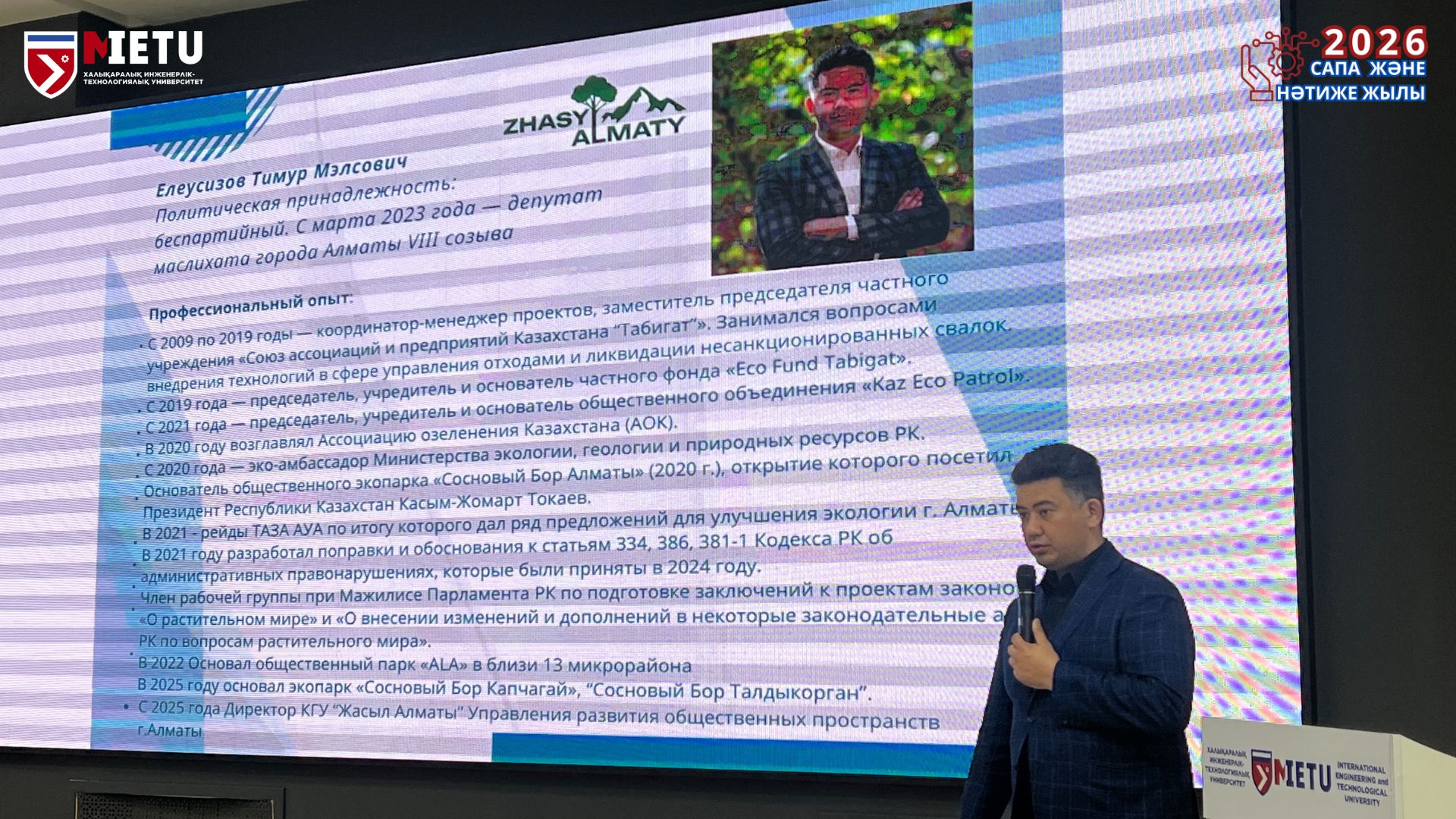
Practical Session “ESG: Science, Education, Business and Society — Synergy for Sustainable Development” Held within the “Taza Kazakhstan” Campaign
At the International Engineering and Technology University (METU), a practical session titled “ESG: Science, Education, Business and Society — Synergy for Sustainable Development” was held as part of the national environmental campaign “Taza Kazakhstan.” The event brought together representatives of academia, business, public organizations, and students to discuss practical approaches to implementing sustainable development principles.
The session was opened by the Rector of the university, Darkhan Berikovich Akpanbetov, who emphasized that ESG approaches have become not merely a theoretical concept but an integral part of modern education, research, and professional practice. He noted that the university’s mission is not only to provide knowledge but also to cultivate a new generation that understands its responsibility to society and the environment.

A key highlight of the event was the signing of a memorandum of cooperation between METU and the municipal institution “Zhasyl Almaty,” aimed at implementing joint environmental initiatives and involving students in practical projects to improve the urban environment. This step symbolized the transition from discussion to concrete action in the field of sustainability.
During the session, speakers from environmental organizations, business, and academia presented their perspectives. Timur Yeleussizov, head of the “Zhasyl Almaty” initiative, spoke about projects focused on developing environmental culture and urban greening. Evgeny Mukhamedzhanov, founder of ECO Network, presented practical solutions for integrating ESG principles into business operations, including green office programs and environmental auditing. The role of science, education, and digital technologies in achieving sustainable development goals was also discussed.
Special attention was given to the educational dimension of ESG. Representatives of the faculty discussed the integration of sustainability principles into academic programs, the training of future specialists, and the development of green entrepreneurship. Demonstrations included the use of digital tools such as sensors, geographic information systems, and analytical platforms for managing environmental resources and urban infrastructure.
The practical session was conducted in an open dialogue format, allowing participants to exchange experiences, discuss real-world cases, and outline directions for future cooperation. Organizers noted that such events contribute to raising environmental awareness among youth and promoting sustainable initiatives.
The meeting became an important step toward implementing ESG principles and demonstrated that the combined efforts of science, education, business, and society can lead to tangible results. Participants expressed confidence that the outcomes of the session would serve as a foundation for new projects, partnerships, and solutions aimed at a sustainable future.