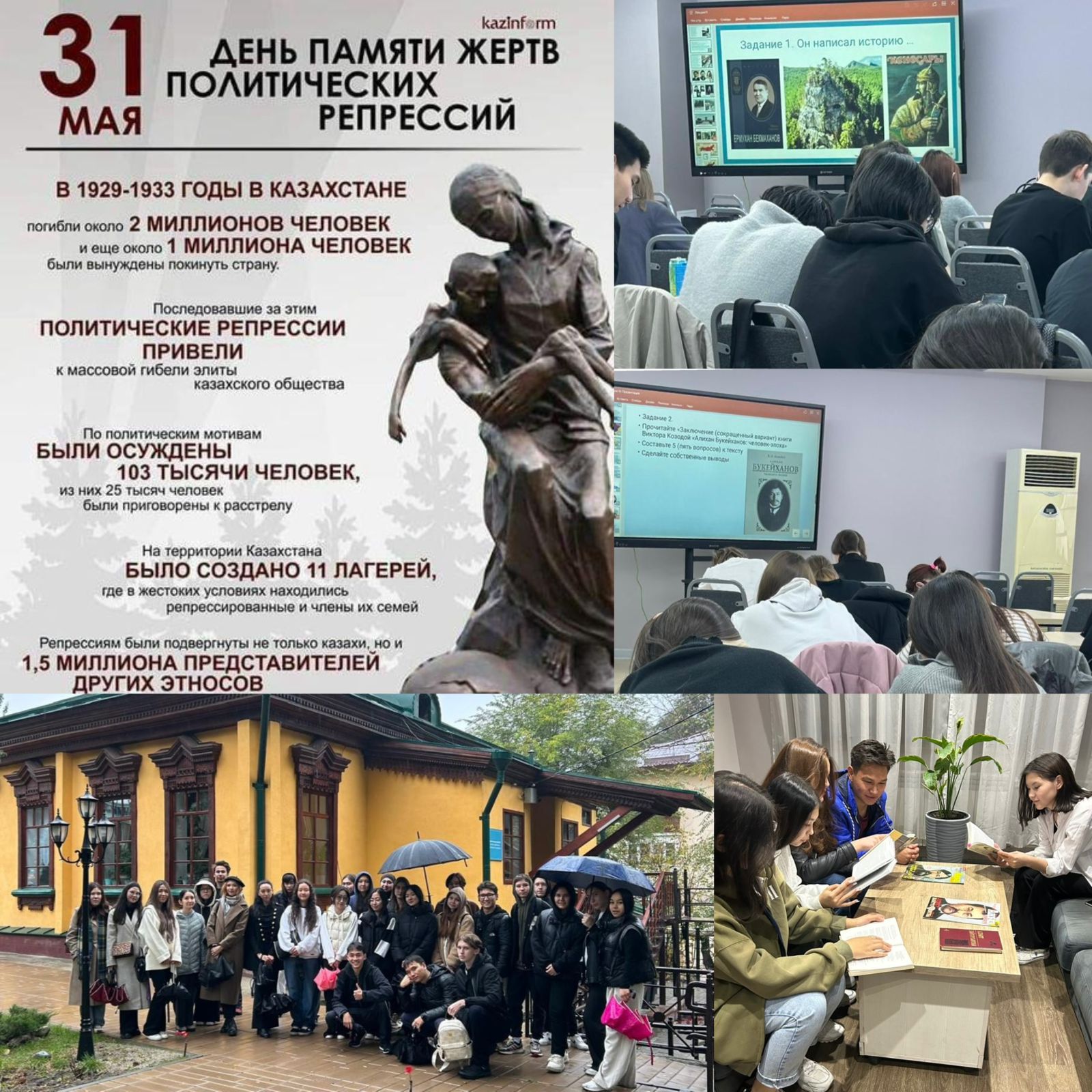
Remembering the Victims of Political Repression and Famine: Our Moral Responsibility
On May 31, 2026, the Day of Remembrance for the Victims of Political
Repression and Famine, the President of the Republic of Kazakhstan,
Kassym-Jomart Tokayev, addressed the nation, calling on citizens to preserve
the memory of those who suffered unjust persecution and punishment as a result
of violations of law and justice. The Head of State emphasized that independent
Kazakhstan consistently creates conditions for the comprehensive protection of
human rights and freedoms. He also identified Justice, Rule of Law, Patriotism,
Diligence, and Respect for Nature as the key values guiding the country`s
future development. Particular attention is being devoted to the advancement of
science, high technologies, culture, and volunteerism.
Within the teaching of the course History of Kazakhstan, lecturers
of the Department of Social Sciences, Humanities, and World Languages place
significant emphasis on the historical events of the 1920s–1950s, a period
marked by mass political repression and the tragic famine of the 1930s. During
lectures and seminars, students examine the lives and activities of prominent
figures who struggled for the revival of national statehood and study the
scholarly legacy of intellectuals who became victims of political persecution.
Among them are Alikhan Bokeikhan, Akhmet Baitursynuly, Mirzhakyp Dulatuly,
Mukhamedzhan Tynyshpaev, Sanjar Asfendiyarov, Yermukhan Bekmakhanov, Alkey
Margulan, Telzhan Shonanuly, and many other distinguished representatives of
the Kazakh intelligentsia. As part of the curriculum, students are introduced
to Viktor Kozodoy’s well-known work Alikhan Bokeikhanov: A Man of an Era. In this study, the author presents
Alikhan Bokeikhan as the leader of the Alash Movement and the Alash Orda
government, highlighting his profound influence on a crucial period in
Kazakhstan’s national history. Unjustly repressed during the Soviet era, he has
since been fully rehabilitated, and his name has been restored to the
historical memory of the nation.
While studying this
period, students also become familiar with the literary and publicistic works
of Akhmet Baitursynuly, including Masa (The Mosquito) and Forty Fables. They learn about his outstanding
contributions to the development of the Kazakh language and literature, as well
as his numerous publications in the newspaper Qazaq. In addition, students visit the Akhmet
Baitursynuly House Museum, gaining a deeper understanding of his life,
scholarship, and educational activities.
Particular attention is devoted to the scholarly legacy of the eminent
historian Yermukhan Bekmakhanov. Students study his research on the national
liberation movement led by Kenesary Kasymov, analyze his historical
interpretations, compare different scholarly perspectives, and develop their
own assessments of historical events. It is well known that Bekmakhanov himself
became a victim of politically motivated persecution and unjust accusations
during the 1950s.
Students also complete
research assignments dedicated to the lives and contributions of repressed
scholars, poets, writers, public intellectuals, and statesmen. Such activities
contribute to a more objective understanding of Kazakhstan’s history, deepen
appreciation for the role of the national intelligentsia in the struggle for
freedom, independence, and cultural revival, and help students comprehend the
tragic consequences of totalitarian policies.
The Constitution of the
Republic of Kazakhstan defines the protection of human and civil rights and
freedoms as one of the fundamental values of the state. Today, the country
continues to implement political and legal reforms aimed at building a Just
Kazakhstan. These initiatives serve to strengthen the rule of law, safeguard
citizens’ rights, and preserve social harmony. Therefore, preserving the memory
of the tragic events of the 1920s–1950s, including political repression and
famine, preventing their recurrence, and upholding historical justice remain
both a civic and moral responsibility of every citizen. By remembering the
lessons of the past, we can continue to strengthen the future of independent
Kazakhstan on the principles of peace, unity, and justice.