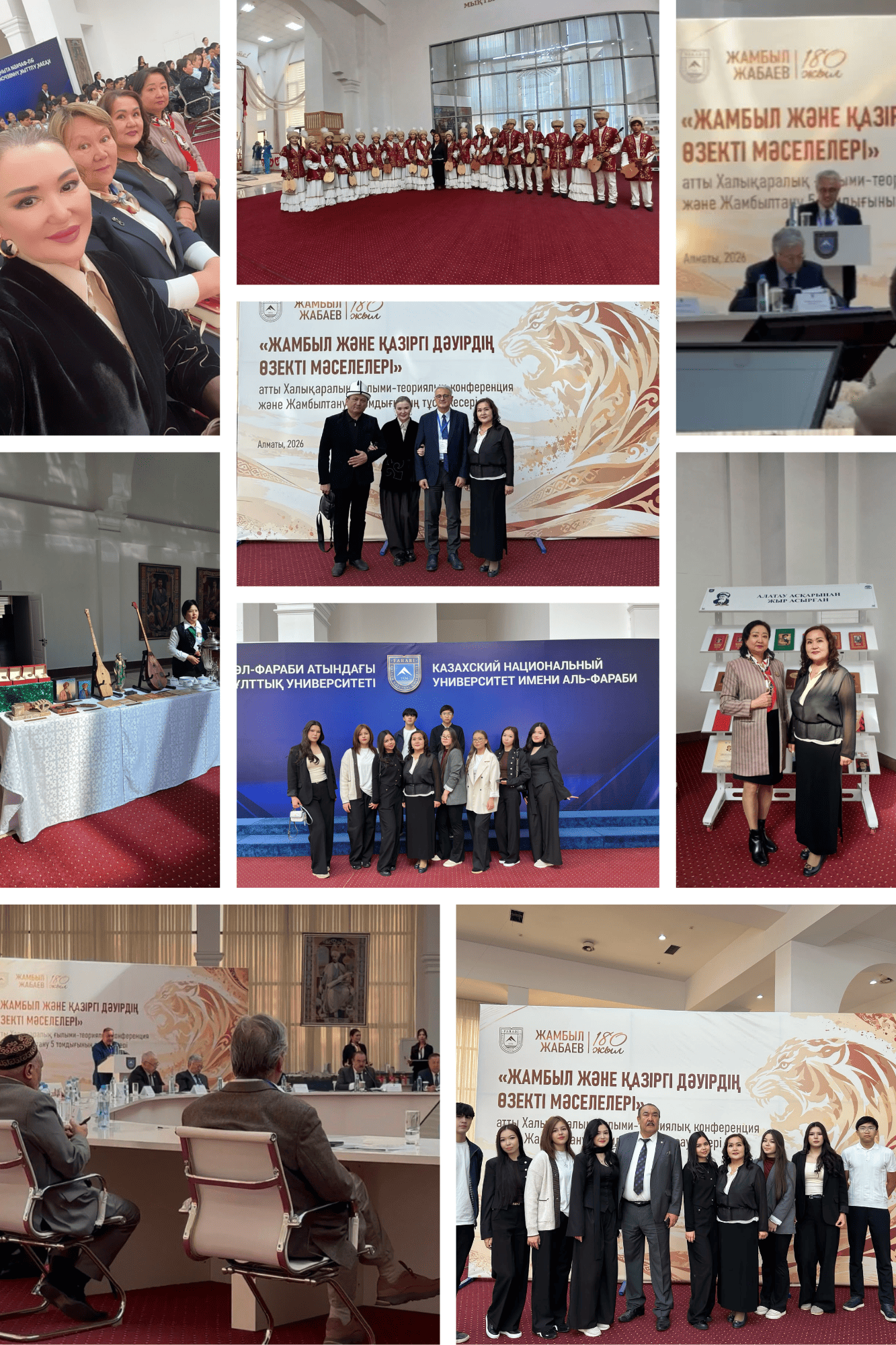
INTERNATIONAL SCIENTIFIC AND THEORETICAL CONFERENCE DEDICATED TO THE 180TH ANNIVERSARY OF ZHAMBYL ZHABAYEV HELD
On October 2, 2026, the Al-Farabi Scientific Library
of Al-Farabi Kazakh National University hosted an international scientific and
theoretical conference dedicated to the 180th anniversary of the great Kazakh
poet and akyn, Zhambyl Zhabayev, as well as the presentation of the five-volume
scholarly publication Zhambyltanu.
The
meaningful scientific event brought together renowned scholars, literary
critics, researchers and representatives of the public from Kazakhstan, as well
as scholars from abroad. The conference addressed the place of Zhambyl’s legacy
in national literature, its significance in the global spiritual heritage, the
artistic and aesthetic nature of the poet’s creative work, and current
directions in Zhambyltanu studies.
The
international scientific forum was attended by Tebegenova Altınaray Temirkhanovna,
Associate Professor of the Department of Social Sciences and Humanities and
World Languages at METU, Candidate of Philological Sciences; Aitkulova Kuralai Ongarovna,
Master of Pedagogical Sciences; and ten first-year students of the department.
During
the conference, the five-volume Zhambyltanu, dedicated to the systematic study
of Zhambyl’s legacy, was presented to the scholarly community. The multi-volume
publication includes works by scholars who have explored the poet’s creative
heritage from various perspectives. Among them is also the monograph by Tebegenova
Altınaray Temirkhanovna, dedicated to Zhambyl’s creative work.
The
participation of university faculty members and students in such a significant
scholarly event provided an opportunity to gain a deeper understanding of the
national literary heritage, strengthen interest in academic research, and
continue the continuity between generations.
Zhambyl’s
legacy is a treasured part of our national spiritual heritage. The
international scientific event dedicated to the poet’s 180th anniversary provided
an opportunity to examine his creative work through new scholarly perspectives
and further emphasized the importance of preserving and passing on Zhambyl’s
rich legacy to future generations.