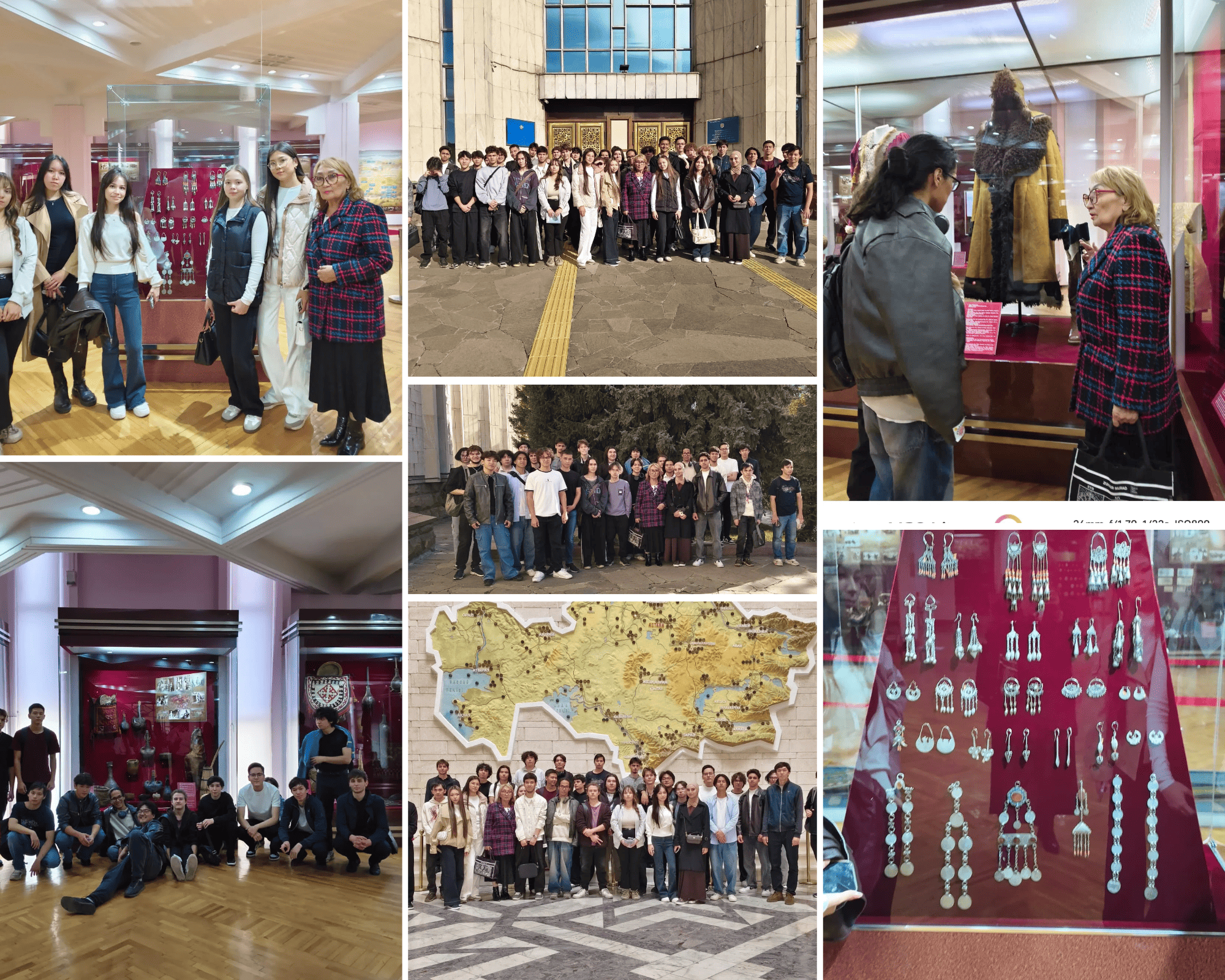
METU STUDENTS VISIT THE NATIONAL CENTRAL MUSEUM OF THE REPUBLIC OF KAZAKHSTAN
On October 8, 2026, students from groups PI-25-1.3 and PI-25-1.4 of METU
University visited the National Central Museum of the Republic of Kazakhstan.
The excursion was organized by Saule Dyusetayevna Shaimukhanova, Associate
Professor of the Department of Social Sciences and Humanities and World
Languages, as part of the university’s educational and extracurricular
activities. Exploring the museum’s exhibitions provided a valuable complement
to classroom learning. Students discovered the country’s history through
archaeological finds, traditional household items, works of applied art,
photographs, and documents that bear witness to the lives and cultures of different
generations. The museum’s exhibitions trace Kazakhstan’s historical journey from
ancient times to the present day. The Paleontology and Archaeology Hall
introduces visitors to the country’s distant past and archaeological heritage,
while the Historical Ethnography Hall presents the traditional culture of the
Kazakh people. National costumes, carpets, household objects, and a traditional
Kazakh yurt illustrate how economic activities, craftsmanship, and spiritual
values shaped everyday life. The History of Kazakhstan Hall highlights the
country’s cultural diversity and preserves the memory of the courage and
contributions of Kazakhstanis on the front lines and at home during the Great
Patriotic War. The Independent Kazakhstan exhibition focuses on the formation
of the sovereign state, its national symbols, currency, and the major
transformations that have taken place since independence. Together, these
exhibits help visitors understand the continuity of the country’s historical
development.
The museum visit
broadened the students’ horizons, strengthened their interest in Kazakhstan’s
history, and fostered respect for the nation’s cultural heritage. Direct
engagement with museum artifacts made the study of the past more vivid and
meaningful. Such excursions are an important part of the department’s
educational activities, bringing together academic learning, cultural
education, and civic and patriotic development. They help students gain a
deeper understanding of their country’s history and appreciate the value of its
cultural heritage.