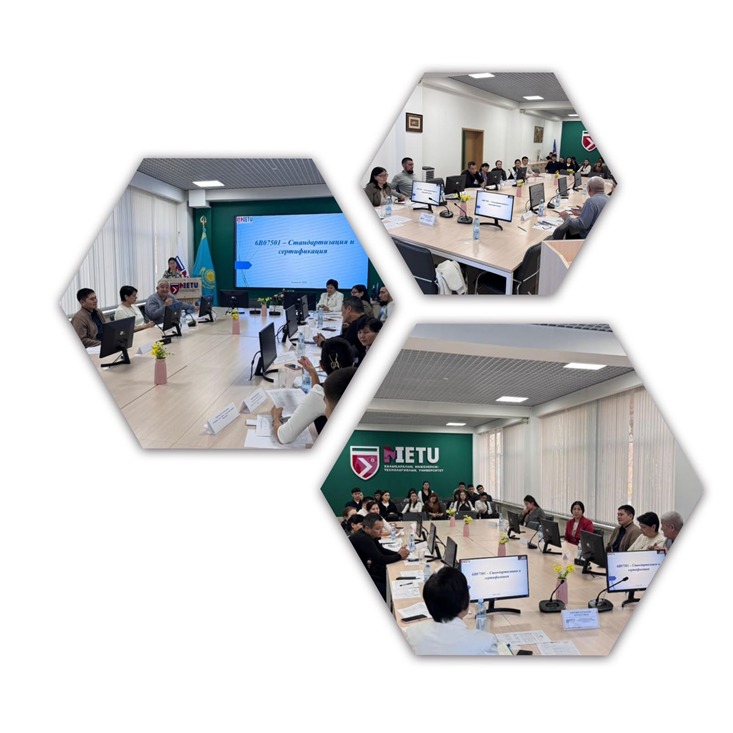
Meeting of the academic committee for the standardization and certification educational program
On February 19, 2026, an open meeting of the Academic Committee for the 6B07501
Standardization and Certification educational program of the Department of
Technique and technology of food production was held at the International Engineering and Technology University (MЕTU). The meeting focused on updating the educational program in line
with current labor market demands, professional standards, and regulatory
requirements.
The meeting brought together
employers, industry experts, faculty members, and students. The participants
reviewed the curriculum and discussed proposals aimed at improving the content
and titles of academic disciplines, strengthening students’ engineering
background, and enhancing the practice-oriented nature of the educational
process.
Gulzira Shabayevna Dzhumabekova,
Lecturer at the Department of Engineering and Technology of Food Production and
Master of Technical Sciences, participated in the meeting. During the
discussion, particular attention was given to aligning the educational program
with employers’ recommendations and current professional requirements in the
field of standardization and certification.
Mairamkul Dzhekshebayevich
Alymbekov, Technical Expert at NCA LLP and Leading Specialist at the
Almaty-Standard Research Center LLP, proposed introducing the course
Theoretical and Applied Mechanics into the curriculum of the 6B07501
Standardization and Certification educational program.
He noted that the course is directly
related to ensuring product quality, safety, and reliability. Studying this
discipline will provide students with the engineering foundation required to assess
the mechanical properties of products, apply technical regulations and
standards correctly, analyze test results, and work with technically complex
objects.
Guzel Molutovna Tokhtiyarova, Head
of the Conformity Assessment Body at the Almaty-Standard Research Center LLP,
proposed including the course Fundamentals of Technical Regulation in the
curriculum. She emphasized that this course is essential for training
specialists in standardization and certification.
The proposed course is intended to
familiarize students with the national technical regulation system, technical
regulations, mandatory product requirements, and the relationship between
technical regulation and standardization. It will also help students develop
practical skills in working with regulatory documents and prepare them for
professional activities in the context of Kazakhstan’s integration into the
international technical regulation system.
Aiganym Sangeldinovna Kubeyeva,
Expert Auditor at Business Expert KZ LLP, proposed renaming the course Quality
Audit as Guidelines for Auditing Management Systems. In her opinion, the new
title more accurately reflects contemporary international auditing approaches
and complies with the provisions of ISO 19011.
The proposed title would broaden the
course to cover audits not only of quality management systems but also of
environmental management, occupational health and safety, and other management
systems. Furthermore, it is consistent with international terminology,
incorporates a risk-based approach, and strengthens the practice-oriented
training of students.
Bereke Dauletqul, a third-year
student of the 6B07501 Standardization and Certification educational program,
expressed students’ interest in studying selected major courses in English. In
her opinion, this would enhance students’ professional competitiveness, expand
academic mobility opportunities, and develop their ability to work with
international standards and foreign regulatory documents.
Following the discussion, the
members of the Academic Committee proposed renaming the course Standardization
and Technical Measurements as Standardization and Technical Regulation. This
change would more accurately reflect the course content and align it with
current legislation and regulatory requirements in the field of technical
regulation.
The proposal to rename the course
Quality Audit as Guidelines for Auditing Management Systems was also supported.
The new title is consistent with ISO 19011 and international terminology and
will allow the course to cover audits of quality, environmental, occupational
health and safety, and other management systems.
As part of the proposed curriculum
amendments, it was recommended that the course Quality Management System in
Standardization and Certification and Life Safety be removed and replaced with
Theoretical and Applied Mechanics. Introducing this course will strengthen
students’ engineering training and develop professional competencies related to
assessing product safety, strength, and reliability.
The participants noted that the
proposed amendments are intended to update the content of the 6B07501
Standardization and Certification educational program, align it with current
professional and regulatory requirements, and improve the quality of specialist
training.
At the conclusion of the meeting,
the participants expressed their willingness to continue cooperating with
employers, industry experts, and students. They emphasized that open meetings
of this kind contribute to the systematic improvement of educational programs
and the training of qualified professionals who meet labor market demands.