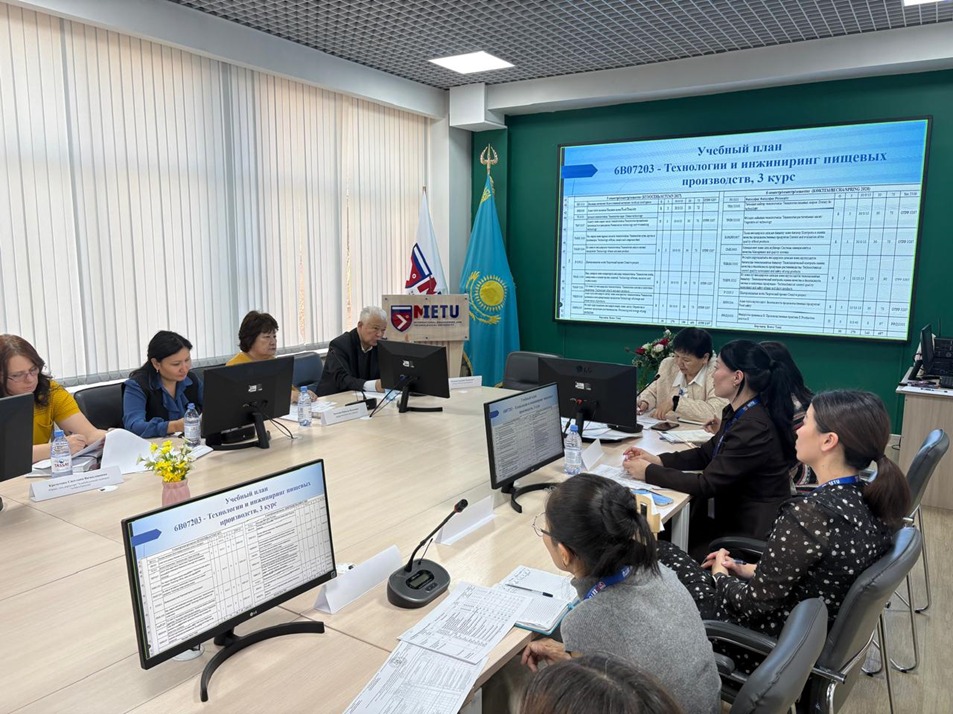
Meeting of the academic committee for the food production technology and engineering educational programs
On February 19, 2026, a meeting of
the Academic Committee for the 6B07203, 7M07204, and 8D07201 Technologies and
engineering of food production educational programs of the Department of Technique
and technology of food production was held at the International Engineering and
Technology University (MЕTU) in Almaty.
The meeting was chaired by Altynai
Burkhatovna Abuova, Head of the Department, Doctor of Agricultural Sciences,
and Professor. A.T. Shartakova served as the secretary of the meeting.
The meeting was attended by A.S.
Abdildayeva, Vice-Rector for Academic Affairs and International Relations;
A.Zh. Zhenisova, Director of the Department of Academic Affairs; U.Ch.
Chomanov, Doctor of Technical Sciences and Professor; A. Dauletkhankyzy,
Department Lecturer and Master of Technical Sciences; representatives of the
ALMATYNAN Bakery Plant LLP; faculty members; and students.
During the meeting, the committee
reviewed the curricula of the bachelor’s, master’s, and doctoral educational
programs and discussed their revision for the 2026–2027 academic year.
Particular attention was paid to introducing new courses, updating course
titles and content, and developing students’ practical, research, and innovation
competencies.
Regarding the 6B07203 Technologies
and engineering of food production bachelor’s program, Svetlana Vyacheslavovna
Krechetova, an employer representative from the ALMATYNAN Bakery Plant LLP,
proposed adding the Sugar Technology course to the curriculum. She noted that
the course would enable students to study sugar production processes and
equipment, develop skills in raw material and finished-product quality control,
and prepare for professional careers in the sugar industry.
Maigul Zhalelovna Kizatova,
Professor at the Department of Technique and technology of food production,
proposed introducing the Technology of Special-Purpose Foods course. The course
is intended to develop knowledge and professional competencies in the design
and production of therapeutic, preventive, dietary, and functional foods.
Zhuldyz Kanatovna Tokanova, Lecturer
at the Department, proposed renaming the Rheology of Food Commodities course as
Rheology of Food Products. It was noted that the new title is more consistent
with current scientific terminology, professional standards, regulatory
documents, and terms commonly used in academic literature.
Akerke Omarova, a fourth-year
student of the 6B07203 educational program, supported the proposed amendments.
She stated that the new courses would deepen students’ professional knowledge,
develop their practical skills, and improve graduates’ competitiveness in the
labor market.
Following the discussion, the
committee decided to introduce the Sugar Technology and Technology of
Special-Purpose Foods courses into the bachelor’s curriculum for the 2026–2027
academic year. It was also decided to rename Rheology of Food Commodities as
Rheology of Food Products.
Regarding the 7M07204 Technologies
and engineering of food production master’s program, Svetlana Vyacheslavovna
Krechetova proposed replacing the Modeling of Technological Processes course
with Green Entrepreneurship and Innovation in the Food Industry. The proposed
course focuses on sustainable development, the green economy,
resource-efficient technologies, and the assessment of environmental and
economic risks.
Professor Urishbek Chomanovich
Chomanov proposed replacing Microbiological Fundamentals of Food and
Fermentation Technology with Technology of Functional and Organic Products. The
proposal reflects the growing demand for functional and organic foods and aims
to develop master’s students’ competencies in innovative product development
and in assessing product quality and safety.
Gulmira Serikbayevna Kenenbay, Associate
Professor at the Department, proposed replacing Non-Traditional Raw Materials
in the Production of Functional and Specialized Foods with Current Issues in
Food Production and Artificial Intelligence. The new course will enable
students to apply artificial intelligence and machine-learning methods in
research and use digital tools to model, predict, and optimize technological
processes.
Professor Maigul Zhalelovna Kizatova
proposed renaming the Food Additives course as Nutrition Science and Dietary Supplement
Technology. The revised course will cover the fundamentals of nutrition
science, the development and production of dietary supplements, and the
assessment of their quality and safety.
Danagul Kamysbayeva, a second-year
master’s student, supported the proposed amendments. She noted that updating
the courses would strengthen the practice-oriented and research training of
master’s students and improve their competitiveness.
Following the discussion, the
committee decided to replace Microbiological Fundamentals of Food and
Fermentation Technology with Technology of Functional and Organic Products and
to replace Non-Traditional Raw Materials in the Production of Functional and
Specialized Foods with Current Issues in Food Production and Artificial Intelligence.
It was also decided to rename Food Additives as Nutrition Science and Dietary
Supplement Technology.
Regarding the 8D07201 Technologies
and engineering of food production program, Professor Altynai Burkhatovna
Abuova proposed replacing Modern Biotechnology and Food Technology with Green
Technologies and ESG Standards. The new course will enable doctoral students to
study the principles of green technologies in the food industry, ESG
requirements, and approaches to environmentally responsible production.
Professor Maigul Zhalelovna Kizatova
proposed renaming Modern Research Methods in Food Production as Modern Research
Methods in Food Production and Certification. The new title reflects the
expanded scope of the course, which covers not only methods for studying and
monitoring technological processes but also product certification in accordance
with applicable standards and regulatory requirements.
Following the discussion, the
committee decided to replace Modern Biotechnology and Food Technology with Green
Technologies and ESG Standards and to rename Modern Research Methods in Food
Production as Modern Research Methods in Food Production and Certification.
The approved amendments are intended
to update the educational programs, integrate sustainable development,
digitalization, and innovative technologies into the learning process, and
strengthen students’ professional and research competencies.
At the conclusion of the meeting,
the members of the Academic Committee emphasized that continued cooperation
with employers, faculty members, and students contributes to the improvement of
educational programs and the training of specialists who meet current labor
market requirements.