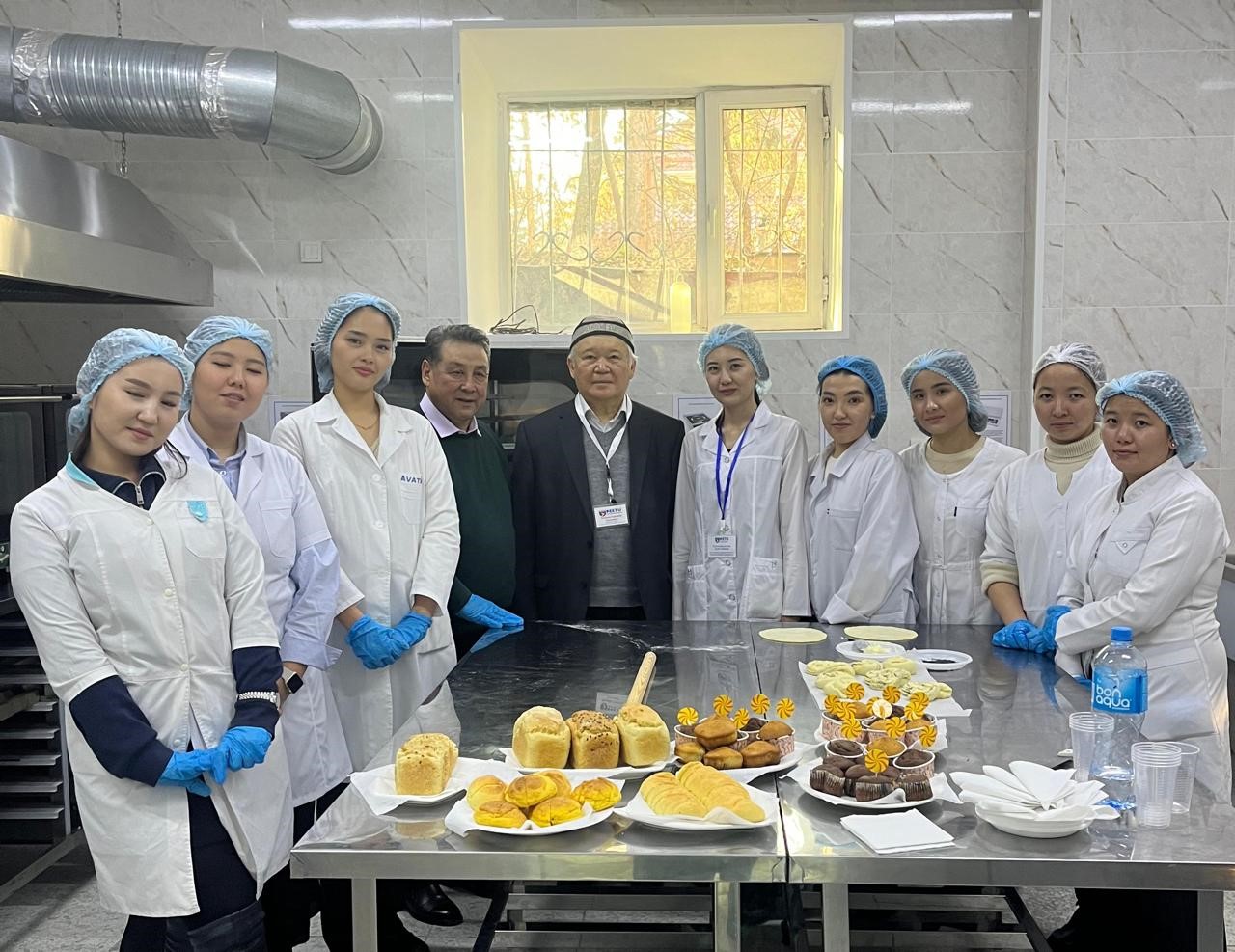
Student club
"Research Technologist" Club
Club leader
G. Temirova and I. Akmuradov
+7 778 676 7589
Раз в месяц
General provisions
The “Technologist Researcher” student research club of the International Engineering and Technological University is a voluntary research association for students interested in food production technology and engineering. It operates on a continuing basis and links theoretical study with practical research.
The club is guided by the laws of the Republic of Kazakhstan on education, science, and technology policy; the University Charter; academic integrity principles; laboratory safety requirements; and these regulations.
Its work is based on voluntary participation, equality, openness, scientific validity, teamwork, responsibility, and the reliability of research findings. The club is not a legal entity and does not pursue commercial objectives.
Mission
To enable students to develop as researchers, innovators, and future food technologists through scientific thinking and practical inquiry in food technology.
Goal
To build students' research and professional competencies by investigating food raw materials and products, improving technological processes, and developing innovative foods with enhanced nutritional value.
Main objectives:
- Investigate physicochemical indicators of food raw materials and products;
- Optimize technological processes;
- Develop new formulations and functional foods;
- Conduct laboratory and experimental research;
- Assess packaging and storage methods;
- Prepare research projects, presentations, and startups.
Main activities:
- Food production technology and engineering;
- Laboratory quality assessment of raw materials and finished products;
- Development of functional and special-purpose foods;
- Sustainable use of secondary raw materials;
- Innovation and startup projects;
- Research conferences and student competitions.
Members' rights:
- Participate in club activities and laboratory research;
- Propose research themes and plan updates;
- Receive relevant scientific and methodological information;
- Develop individual or team projects;
- Present findings at conferences and competitions;
- Withdraw from the club voluntarily.
Members' responsibilities:
- Follow safety, sanitation, and laboratory requirements;
- Adhere to academic integrity;
- Complete the approved plan and assigned tasks;
- Record research findings objectively;
- Avoid actions that may damage the reputation of the club or university.
Structure and management
The club consists of scientific supervisors, a chairperson, a secretary, and permanent members. Temporary research teams may be established for specific projects. Meetings follow the approved plan, and decisions are formally recorded in minutes.
Responsibilities of the governing bodies:
- The scientific supervisors define research areas, methods, and expected outcomes and ensure that experiments meet scientific and safety requirements;
- The chairperson convenes meetings, coordinates activities, helps allocate responsibilities, and prepares the annual report;
- The secretary maintains minutes, attendance lists, research records, and reporting documents;
- Project leaders ensure completion of practical work, accurate data recording, and timely presentation of results.
Membership
University students interested in research in food production technology and engineering may become members. Admission is based on a student application or a supervisor's recommendation. Faculty, master's and doctoral students, and industry specialists may serve as advisers.
Termination of membership:
- Voluntary withdrawal;
- Repeated absence without a valid reason;
- Violation of safety requirements, academic integrity, or university rules;
- Intentional falsification of research findings or conduct damaging the club's reputation.
Club members:
- Arailym Torekhanova — TiPP-23-1.3k;
- Uraiym Sakenkyzy — TiPP-23-1.3k;
- Akmaral Zheksenbay — TiPP-23-1.3k;
- Batyrkhan Khamit — TiPP-23-1.3k;
- Madina Bekmuratova — TiPP-23-1.3k;
- Ksenia Leonidovna Morozova — TiPP-23-1r;
- Daniyar Timuruly Khalil — TiPP-23-1.2k;
- Karina Talgatovna Ramazanova — TiPP-23-1r.
Final provisions
These regulations take effect after approval under the University's established procedure. A work plan is prepared for each academic year and agreed with the department. Amendments may be proposed by the supervisors, club members, or the department. Annual results are presented as a report, presentation, and research outputs.
Work plan for the 2026–2027 academic year:
| No. |
Topic |
Format |
Period |
| 1 | Organizational meeting, allocation of research themes, and physicochemical analysis of food raw materials | Meeting, lecture, laboratory research | September 2026 |
| 2 | Optimization of food-processing operations | Practical session | October 2026 |
| 3 | Development of an innovative food product | Formulation development | November 2026 |
| 4 | Wafer products for specialized nutrition using fruit raw materials | Experimental research and project | December 2026 |
| 5 | Flour confectionery enriched with grain-legume ingredients | Experimental research and project | January 2027 |
| 6 | Fermented milk beverage based on whey and fruit or berry juices | Practical session | February 2027 |
| 7 | Functional cookies based on oat flour and apple-processing products | Practical session | March 2027 |
| 8 | Food packaging and storage | Practical session | April 2027 |
| 9 | Techno-economic assessment of the development | Report and presentation | May 2027 |
| 10 | Lactose-free yogurt production technology | Startup project and prototype | Throughout the year |